
Book Appointment Now

Peyronie's Disease Treatment in Woodford
Focused shockwave therapy provides a non-invasive medical solution for Peyronie’s disease by directing precise acoustic energy into hardened penile plaque to stimulate tissue remodeling. VitalWave delivers this advanced regenerative treatment at our clinic for men in Woodford, helping individuals overcome painful erection symptoms and structural curvature without surgery.
This therapeutic pathway addresses the root vascular and structural causes of erection difficulty, offering a long-term alternative to temporary fixes like daily pills or invasive treatments.
Understanding Peyronie's Disease
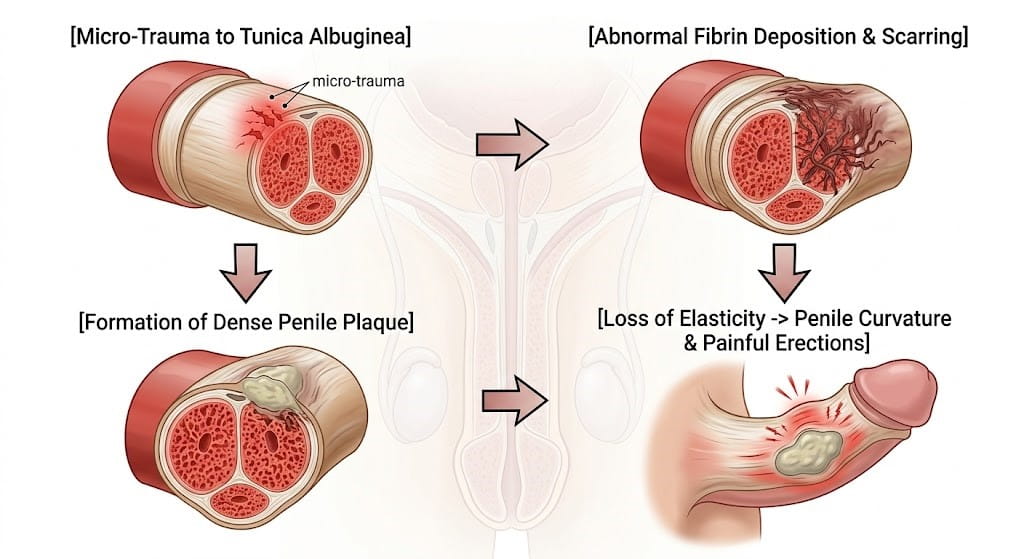
Peyronie’s disease is an acquired connective tissue disorder characterized by the formation of a dense penile plaque (fibrous scar tissue) within the tunica albuginea of the penis.
This localized loss of elasticity causes a noticeable curvature, shortening, or indentation of the penile shaft during tumescence.
For many men, the physical distortion is accompanied by a painful erection, severe anxiety, and mechanical erection failure during intercourse.
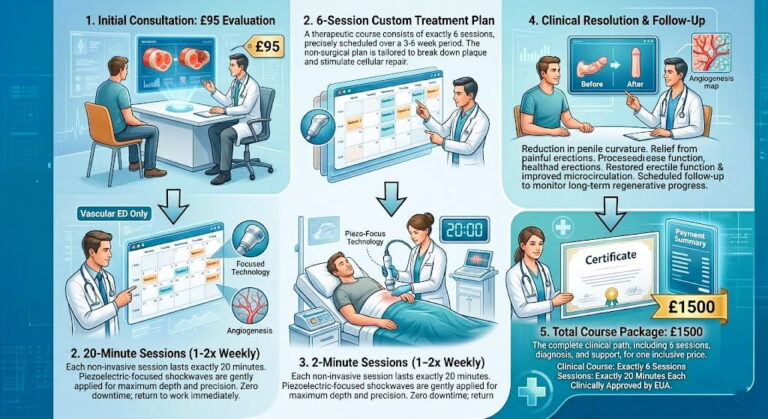
When managing ED and structural disorders like Peyronie’s, clinical precision is paramount. The condition often disrupts local vascular pathways, leading to secondary erectile dysfunction symptoms due to restricted arterial inflow.
Left untreated, chronic inflammation stabilizes into calcified plaques, making early medical intervention essential for restoring natural anatomy and stabilizing penile health.
Technical Definitions
To understand how acoustic waves repair compromised tissue, it is helpful to define the core biological processes involved in this clinical treatment:
Angiogenesis
The physiological process through which new blood vessels form from pre-existing vessels, increasing microvascular perfusion and restoring blood flow to downstream tissues.
Piezoelectric Effect
The generation of acoustic shockwaves via the electrical excitation of ceramic crystals arranged within a transducer head, producing a highly focused, deep-penetrating therapeutic beam.
Mechanotransduction
The cellular mechanism by which physical mechanical forces (such as acoustic pressure waves) are converted into chemical and biological signals, triggering cellular repair and growth factor release.
Tunica Albuginea
The tough, fibrous envelope of connective tissue surrounding the corpora cavernosa of the penis, which becomes inelastic when affected by Peyronie’s plaque formation.
Macro vs. Micro-Context Exploration
Understanding who will benefit from low-intensity extracorporeal shockwave therapy requires a clear distinction between structural or vascular damage and other physiological or neurological etiologies.
Target Clinical Indicators
Vascular ED and Plaque-Induced Curvature: Patients experiencing structural curvature from Peyronie’s disease or erection difficulty caused by arterial plaque buildup.
Impaired Microcirculation: Individuals who fail to achieve or maintain sufficient rigidity due to restricted blood flow through the cavernous arteries.
Primary Biomarkers: Objective signs of erectile tissue damage, localized fibrous nodules, and mechanical restriction during tumescence.
Ineligible Contraindications
Prostate Cancer Nerve Damage: Men experiencing severe erectile dysfunction following a radical prostatectomy due to severed or compromised cavernous nerves.
Hormonal and Endocrine Imbalances: Impotence rooted primarily in severe hypogonadism (low testosterone) or advanced, uncontrolled endocrine disorders.
Psychological ED & Neurogenic Dysfunction: Erection failure arising from severe clinical anxiety, psychological trauma, spinal cord injuries, or central nervous system disorders.
Frequently Asked Questions
What is the documented success rate for focused shockwave therapy at your clinic?
The clinical success rate exceeds 75% in clinically suitable patients presenting with documented vascular erectile dysfunction or early-to-mid stage Peyronie’s disease.
This statistical outcome is achieved through strict patient selection criteria that screen out individuals with severe neurogenic damage, uncontrolled endocrine disorders, or complete plaque calcification.
How does this treatment compare to a peyronies device or traction therapy?
Focused shockwave therapy treats the structural condition by utilizing deep-penetrating acoustic energy to break down the dense penile plaque on a cellular level, whereas a peyronies device relies on mechanical traction over several hours a day to physically stretch the tissue.
Clinical evidence shows that while traction devices can assist with length retention, focused shockwaves actively stimulate angiogenesis and tissue remodeling to restore natural elasticity without the discomfort of daily mechanical bracing.
Is the focused shockwave procedure painful for the patient?
No, the treatment is not painful and is well-tolerated by patients without the use of local anesthetics or numbing creams. The advanced piezoelectric delivery system emits a precise, low-level acoustic tapping sensation against the skin surface.
The specialist adjusts the energy flux density throughout the 20-minute session to match individual comfort levels while maintaining therapeutic efficacy.
How quickly can a patient return to normal activity after a session?
A patient can return to full personal and professional activities immediately following their 20-minute appointment, as there is zero recovery downtime associated with this non-invasive technology.
Because the piezoelectric waves bypass the epidermal layers without causing surface micro-tears or skin breakdown, there are no structural restrictions regarding exercise, driving, or sexual intercourse post-treatment.
How is patient privacy maintained at your erectile dysfunction clinic?
Patient discretion is maintained by integrating all specialist appointments within a high-volume, multi-disciplinary osteopathy and physiotherapy clinic in Woodford.
Your medical booking is designated in the scheduling system as a standard “Shockwave Session”—a term identical to those used for common musculoskeletal procedures like plantar fasciitis or Achilles tendinopathy treatment.
This setup ensures that your true clinical intent remains strictly confidential between you and your attending medical professional.
Is focused shockwave therapy approved by international medical boards?
Yes, this therapeutic modality is officially approved by the European Association of Urology (EAU) and the International Society for Sexual Medicine (ISSM) as a first-line, non-invasive therapeutic intervention for vascular erectile dysfunction.
Numerous double-blind, sham-controlled clinical trials validate its capacity to induce tissue neovascularization and safely degrade localized fibrous plaques.
What are the earliest visual signs of erectile tissue damage?
The earliest signs of erectile tissue damage include a gradual or sudden loss of rigidity during intercourse, a persistent ache or pain on erection, and the development of localized induration or firm nodules along the shaft.
If you observe structural shifting, unprovoked curvature, or a rapid loss of erection when changing positions, an objective diagnostic evaluation is recommended to assess your vascular health.