
Book Appointment Now

Focused Shockwave vs. Traction Devices: Evaluating RestoreX Protocols for Tissue Remodeling
For men navigating the physical and psychological challenges of Peyronie’s disease, selecting a conservative treatment pathway can be overwhelming. The medical landscape has evolved significantly past long, uncomfortable clinical protocols.
Today, advanced non-surgical interventions center around two primary methodologies: physical mechanical tension via specialized devices and high-energy cellular disruption via focused shockwave therapy.
At Vital Wave – Mens Health Shock Wave Therapy Clinic – Woodford, our clinical team evaluates these modalities not as mutually exclusive choices, but as highly collaborative components of modern regenerative urology.
Under the clinical guidance of Robert Shanks, a registered UK Osteopath and elite EMS Swiss DolorClast trainer, and Dr. Kishore Bahl, a specialist grade urologist with over 20 years of NHS experience, our Woodford Green clinic specializes in resolving complex tunica tissue abnormalities safely and effectively.
Why the Tunica Albuginea Scars
Peyronie’s disease is fundamentally a microvascular and structural tissue disorder. It begins when localized microtrauma to the erect penis triggers an abnormal, prolonged inflammatory response in genetically susceptible individuals.
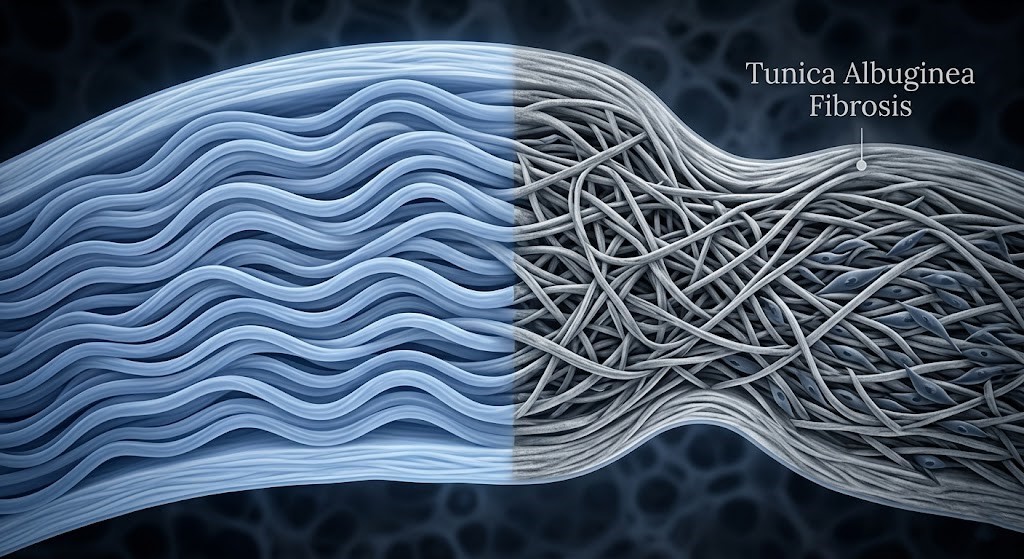
This localized inflammation leads to the hyper-proliferation of fibroblasts and the subsequent deposition of a dense, disorganized collagen scar matrix known as a fibrotic plaque.
This plaque typically develops within the tunica albuginea—the bi-layered elastic sheath surrounding the erectile chambers (corpora cavernosa). Because this fibrotic plaque lacks the natural elasticity of healthy tissue, it prevents the affected side of the shaft from expanding during an erection.
The surrounding healthy tissue continues to expand normally, resulting in a pronounced curvature deformity, physical indentation, localized pain, and frequently, a noticeable loss of stretched penile length (SPL).
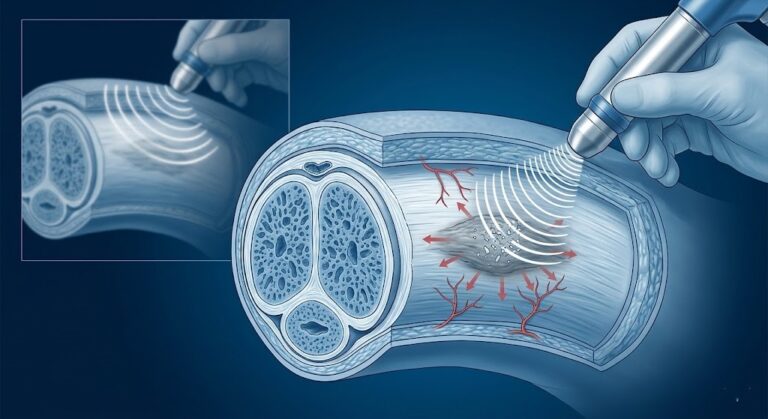
Restore X and Penile Traction Therapy (PTT)
Historically, using a male traction device required an exhausting commitment of four to six hours of continuous daily wear, severely limiting patient compliance and causing skin breakdown. Modern bioengineering has shifted this paradigm entirely through the development of specialized traction protocols.
The preeminent technological tool in this category is restore x, a specialized mechanical device engineered in cooperation with the Mayo Clinic. The core mechanism behind a modern peyronies device like this is a biological process called mechanotransduction.
Controlled, sustained mechanical force is applied to the tunica albuginea, it creates a cellular-level strain across the fibrotic plaque.
This mechanical tension triggers specific intracellular signaling pathways that instruct local fibroblasts to produce endogenous matrix metalloproteinases (MMPs)—enzymes responsible for breaking down the dense, locked collagen fibers. Simultaneously, this traction forces new collagen fibers to realign in a linear, parallel configuration rather than a chaotic, curved knot.
The primary structural advantage of this specific design over older generation traction rigs includes:
Optimized Clamping Force: Distributes pressure over a wider surface area to avoid localized tissue ischemia or slippage.
True Counter-Traction Bending: Allows direct, localized force opposite to the direction of the curvature, maximizing the impact on the plaque core.
Shortened Wear Protocols: Achieves clinically documented cellular remodeling in just 30 to 60 minutes per day, typically broken down into two 30-minute sessions.
Evaluating RestoreX Before and After Pictures: Realistic Curvature and Length Recovery
When prospective patients study peer-reviewed data or examine restorex before and after pictures, understanding clinical baselines is essential to maintaining realistic therapeutic expectations. Clinical trial parameters published in major urologic literature show that consistent, protocol-compliant traction therapy yields predictable structural tissue changes over a 12-week to 24-week period.
| Clinical Parameter | Average Trial Outcome (3-6 Months) | Patient Reality & Compliance Factors |
| Curvature Reduction | 17° to 21° average improvement (~28% reduction) | Dependent on plaque calcification levels and compliance. |
| Length Restoration | 1.5 cm to 2.3 cm gain in Stretched Penile Length | Achieved by expanding healthy unscarred tunica segments. |
| Functional Restoration | 80% of previously restricted men restored penetrative capability | Dependent on baseline erectile function and plaque location. |
| Adverse Event Profile | Zero permanent complications; transient minor numbness | Minor glans cooling or temporary color shifts resolve within minutes. |
Focused Extracorporeal Shockwave Therapy (fESWT) for Plaque Disruption
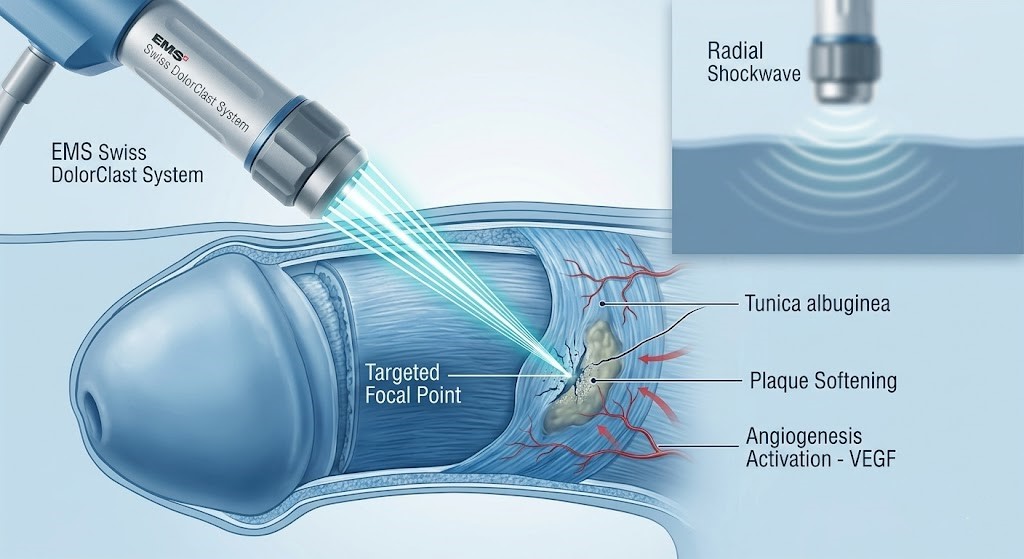
To address the limitations of mechanical traction, our Woodford clinic utilizes Focused Extracorporeal Shockwave Therapy (fESWT). It is critical for patients to recognize the vast clinical divide between superficial radial waves and true focused shockwaves.
Radial devices release a spreading, acoustic wave that loses energy rapidly as it leaves the applicator head, making them ideal for superficial soft tissue injuries but largely ineffective against dense penile plaques.
In contrast, focused shockwaves use electrohydraulic, electromagnetic, or piezoelectric mechanisms to converge high-energy acoustic pulses onto an exact focal point inside the tunica albuginea.
At Vital Wave, we deploy the world-leading EMS Swiss DolorClast system—widely recognized as the pinnacle of clinical shockwave technology for its precise energy flux density and absolute power consistency. When these high-energy acoustic pulses meet the boundary layer of the fibrotic plaque, they generate targeted physical microtrauma without damaging the overlying skin or adjacent vascular structures.
This acoustic disruption accomplishes three distinct therapeutic goals:
Plaque Softening: Breaks up micro-calcifications within the scar matrix, restoring immediate physical pliability to the tunica albuginea.
Angiogenesis Activation: Up-regulates Vascular Endothelial Growth Factor (VEGF), stimulating the development of new micro-capillaries to reverse underlying endothelial dysfunction.
Metabolic Stimulation: Triggers a localized influx of macrophages and inflammatory mediators that systematically resorb broken-down plaque fragments.
Selecting the Right Protocol in Woodford
Every case of Peyronie’s disease demands an individualistic approach based on whether the condition is in the active (inflammatory) phase or the chronic (stable) phase. The active phase is often marked by painful erections and changing curvature, whereas the chronic phase features stable, painless curvature accompanied by hardened, mature plaques.
Choosing the ideal combination of clinical shockwave therapy and at-home mechanical devices requires a meticulous, face-to-face evaluation. During your consultation at Vital Wave, our specialists map the plaque location, measure baseline curvature dynamics, and screen for concurrent issues like vasculogenic erectile dysfunction or pelvic floor hypertonicity.
We provide a direct, evidence-based roadmap that safely guides you through a customized Peyronie’s disease treatment plan designed to avoid the long-term risks of surgical plication or grafting.
Clinic Overview & Patient Support
Our private facility is structured to ensure absolute discretion, clinical safety, and data-driven results for men traveling from across Woodford, Chigwell, and Greater London.
Clinic Address: Vital Wave – Mens Health Shock Wave Therapy Clinic – Woodford, 5 Jubilee Market, St Barnabas Road, Woodford Green, IG8 7BZ
Direct Inquiries & Bookings: 0333 444 4834
Digital Intake Portal: woodford.vitalwave.co.uk
Operating Hours: Monday through Friday, 09:00 to 21:00; Saturdays, 09:00 to 18:00. (Discreet scheduling by appointment only).
Would you like to book a private clinical consultation with our medical urology team?