
Book Appointment Now

Focused Shockwave Therapy in Woodford
Chronic pain can turn everyday life into a challenge—whether it’s heel pain, a lingering shoulder injury, or pelvic floor dysfunction. When rest, ice, and standard therapy stop delivering results, surgery shouldn’t feel like the only option.
Extracorporeal Shockwave Therapy (ESWT) is a non-invasive, NICE-approved treatment designed to stimulate your body’s natural healing process and support recovery in stubborn, hard-to-heal tissues.
What is Shockwave Therapy?
Extracorporeal Shockwave Therapy—often referred to as ESWT, sonic wave therapy, or sound wave treatment—is a specialized therapeutic intervention that transmits high-energy acoustic waves directly through the skin into damaged musculoskeletal or vascular structures.
Unlike standard ultrasound therapies that use low-energy, continuous waves primarily to generate deep thermal warmth, a shockwave machine delivers an entirely different type of energy. It releases a single, highly intense acoustic pulse characterized by an instantaneous jump in pressure, followed by a brief phase of negative pressure.
The Biological Response
The therapeutic power of sound wave treatment rests on a biological process called mechanotransduction. When these rapid acoustic pressure waves hit damaged or dense tissues, they exert physical force on a cellular level. This mechanical stress initiates a chain reaction of positive biological healing responses:
Neovascularization: The acoustic micro-trauma stimulates the release of growth factors like VEGF (Vascular Endothelial Growth Factor). This process signals the body to sprout new microscopic blood vessels, drastically improving oxygenation and nutrient delivery to areas that typically have a poor blood supply, such as tendons.
Cellular Regeneration and Collagen Synthesis: Shockwaves prompt the activation of tenocytes (tendon cells) and fibroblasts, accelerating the production of pro-collagen to actively rebuild damaged, frayed, or scarred soft tissues.
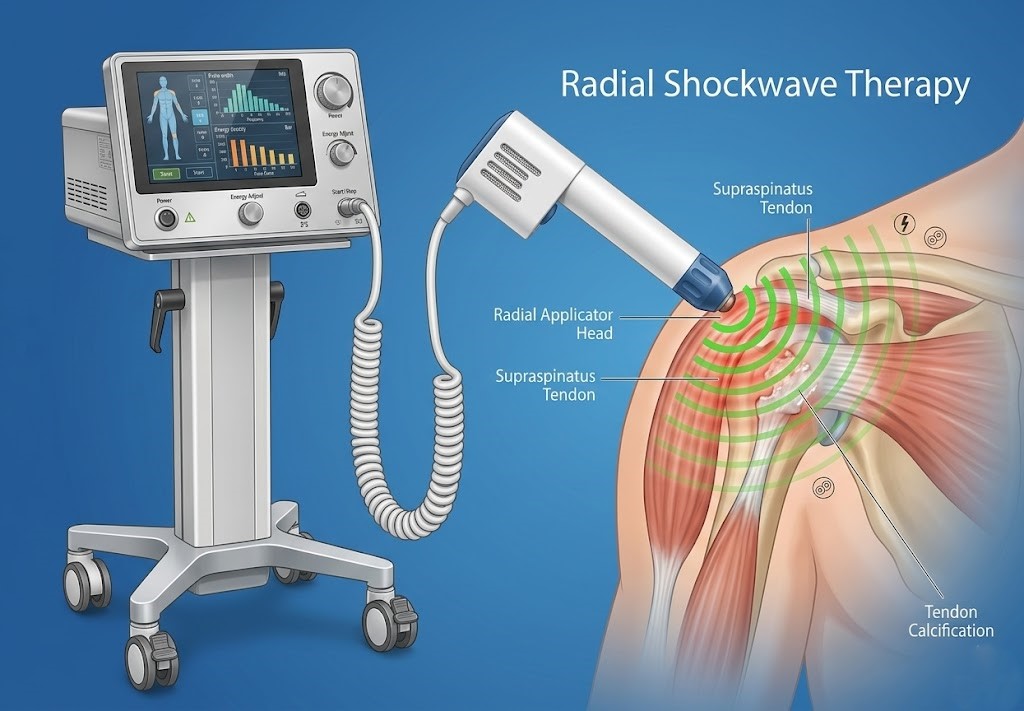
Disruption of Calcifications: In conditions like calcific tendinitis of the shoulder, the mechanical forces help fracture and break down brittle calcium deposits, allowing the lymphatic system to safely resorb the fragments.
Immediate and Long-Term Pain Relief: The sudden overstimulation of local nerve fibers blocks pain signals from traveling to the brain (satisfying the Gate Control Theory of Pain). Concurrently, it reduces the local concentration of Substance P, a key neurotransmitter associated with chronic, intense pain.
Core Terminology
To navigate this advanced medical landscape effectively, it is helpful to clarify several terms often found in patient reviews and clinical literature:
Extracorporeal: Occurring or performed entirely outside the physical body.
Cavitation: The formation and rapid collapse of microscopic gas bubbles within tissue fluids caused by the negative pressure phase of a shockwave. This action physically alters dense scar tissue.
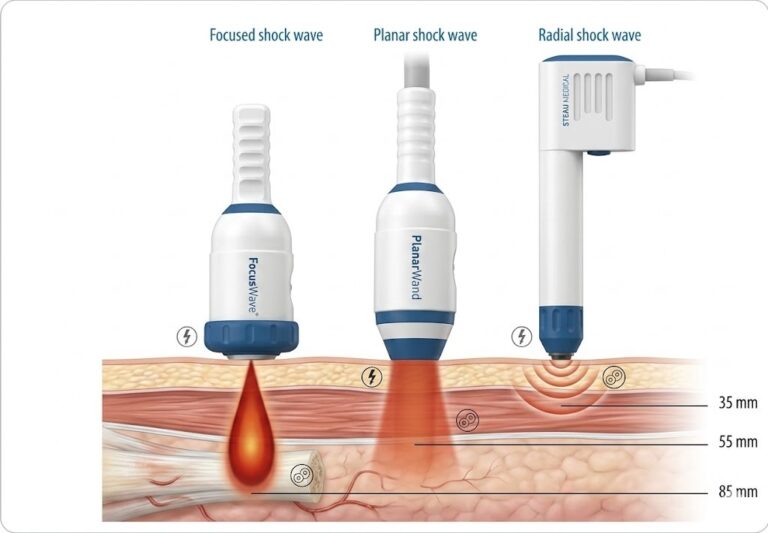
Radial Shockwave (RSWT): Pneumatically generated pressure waves that expand outward across a wider, shallower surface area.
Focused Shockwave (FSWT): Electromagnetically or piezoelectrically generated shockwaves that converge precisely at a predetermined depth beneath the skin, targeting deeper tissues without causing surface discomfort.
Radial Shockwave Therapy (RSWT)
Radial systems utilize a compressor to drive a projectile within a handpiece, striking an applicator tip placed against the skin. This impact creates a wave that disperses outward in a cone shape.
Energy Profile: The energy hits its maximum intensity at the immediate skin surface and rapidly dissipates as it travels deeper.
Penetration Depth: Typically reaches optimal therapeutic levels between 0 mm and 35 mm.
Primary Targets: Widespread, superficial soft tissue issues, large muscle groups, and surface-level tendon issues. It functions exceptionally well as a specialized “shock therapy for muscles,” breaking down dense myofascial trigger points and treating large areas like the calves or hamstrings.
Focused Shockwave Therapy (FSWT)
Focused systems utilize electromagnetic or piezoelectric crystals to generate an acoustic wave that is shaped and steered by an acoustic lens.
Energy Profile: The acoustic energy passes smoothly through the upper skin layer without releasing its peak force on the surface. Instead, the waves converge at an exact focal spot deep within the body, concentrating the maximum energy directly onto the lesion.
Penetration Depth: Can be precisely adjusted to reach depths between 30 mm and 125 mm.
Primary Targets: Deep-seated tendon insertions (such as a deep hip bone bursitis or a high Achilles injury), bone non-unions, and delicate pelvic floor or vascular treatments involved in men’s health conditions. It offers a highly accurate, deep-penetrating wave therapy treatment that treats deep issues without skin irritation.
Musculoskeletal Applications
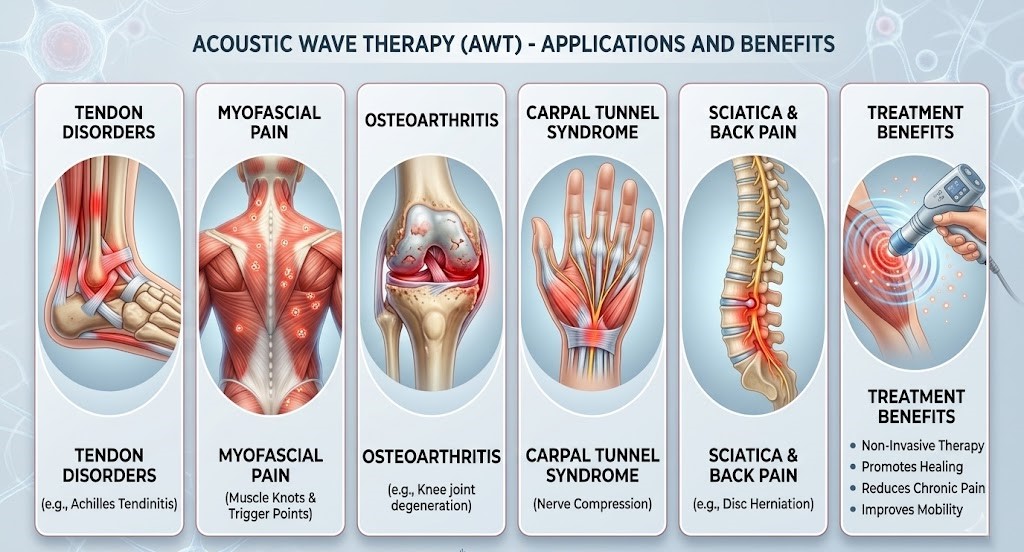
For anyone dealing with a stubborn sports injury or chronic, everyday back problem, ESWT offers a targeted, regenerative alternative to temporary options like deep tissue massage or standard physical treatments.
When tracking your condition on a 1-to-10 pain scale, watch for these primary musculoskeletal indications where shockwave therapy provides a definitive path to tissue repair:
Lower Limb Indications
Plantar Fasciitis and Heel Spurs: Often felt as a sharp, stabbing pain on your first steps out of bed. ESWT functions as an intensive “shock therapy for feet,” stimulating blood flow and breaking down stiff, chronically inflamed plantar fascial tissues.
Achilles Tendinitis (ESWT Achilles Protocols): Whether you are dealing with mid-portion Achilles soreness or hard insertional pain where the tendon connects to the heel bone, focused shockwaves restart a strong healing response in this poorly vascularized tendon, helping you recover from stubborn running injuries.
Patellar Tendinitis (Jumper’s Knee) & Quadriceps Tendinitis: Common in athletes who perform explosive jumping or running. ESWT targets the precise point of tendon strain beneath or above the kneecap, eliminating knee pain and allowing the tendon fibers to realign cleanly.
Upper Limb & Torso Indications
Shoulder Impingement & Subacromial Pain Syndrome (SAPS): When a strained rotator cuff or a sore rotator cuff makes lifting your arm overhead excruciating, focused shockwaves can penetrate deep into the shoulder joint capsule. This reduces localized bursitis and triggers repair in micro-tears without requiring invasive cortisone injections.
Tennis Elbow & Golfer’s Elbow (Epicondylitis): Chronic strains at the inner or outer attachment points of the elbow forearm muscles. Shockwave treatment efficiently breaks up the tight, painful scar tissue that accumulates from repetitive wrist movements.
Greater Trochanteric Pain Syndrome (Hip Bursitis): For individuals experiencing a deeply painful hip bone that makes sleeping on their side impossible, focused shockwave therapy precisely reaches the deep gluteal tendon attachments and bursae to relieve persistent inflammation.
Chronic Back Pain: When a persistent back problem resists manual therapy, radial shockwave applications can be utilized across the tight spinal musculature. This releases deep tissue restrictions, resets hypertonic muscles, and offers an effective option for how to relieve chronic back pain.
Clinical Safety, Realities, and Contraindications
While shockwave therapy is a non-invasive, highly secure intervention, maintaining professional clinical safety guidelines is essential to protect patient health.
Shockwave Therapy Contraindications
An expert therapist will always conduct a thorough medical screening prior to treatment. Shockwave therapy must not be applied if any of the following contraindications are present:
Pregnancy: It cannot be used anywhere near the abdomen, lower back, or pelvic structures.
Blood Clotting Disorders or Anticoagulant Use: Individuals taking heavy blood thinners (like Warfarin) carry an elevated risk of severe bruising or tissue bleeding.
Active Malignancy: Shockwaves must never be applied over an identified or suspected cancerous tumor site, as increased blood flow could encourage cellular proliferation.
Pacemakers and Implanted Electronics: Focused shockwaves can potentially disrupt the internal circuitry of nearby cardiac devices.
Steroid Injections: If you have received a localized cortisone injection in the target area, you must wait a minimum of 4 to 6 weeks before undergoing shockwave therapy. Applying shockwaves too soon can interfere with the steroid’s effects and overstress tissues temporarily weakened by cortisone.
Acute Infections or Open Wounds: The treatment cannot be applied over actively infected skin or unhealed surgical incisions.
Managing Patient Expectations
It is completely natural to look up shockwave warfare reviews or worry about the sensation of the treatment.
During a session, you will feel a rhythmic, tapping or knocking sensation. When treating an inflamed tendon, this can feel like a deep, dull ache. Your clinician will carefully scale the energy intensity based on your real-time feedback, ensuring the procedure remains completely manageable.
Following treatment, you may experience minor localized side effects over the next 24 to 48 hours, including light skin redness, minor swelling, a superficial dull ache, or light bruising. These are normal signs that your body’s inflammatory healing response has been successfully activated.
Unlike invasive surgery, there is zero downtime. You can walk out of the clinic and resume normal, low-impact daily activities immediately. However, you should avoid heavy weightlifting, high-impact running, or intense exercise involving the treated area for 48 hours following each session to allow the targeted tissues to heal.
Frequently Asked Questions
What is the documented success rate for focused shockwave therapy at your clinic?
The clinical success rate exceeds 75% in clinically suitable patients presenting with documented vascular erectile dysfunction or early-to-mid stage Peyronie’s disease.
This statistical outcome is achieved through strict patient selection criteria that screen out individuals with severe neurogenic damage, uncontrolled endocrine disorders, or complete plaque calcification.
How does this treatment compare to a peyronies device or traction therapy?
Focused shockwave therapy treats the structural condition by utilizing deep-penetrating acoustic energy to break down the dense penile plaque on a cellular level, whereas a peyronies treatment device relies on mechanical traction over several hours a day to physically stretch the tissue.
Clinical evidence shows that while traction devices can assist with length retention, focused shockwaves actively stimulate angiogenesis and tissue remodeling to restore natural elasticity without the discomfort of daily mechanical bracing.
Is the focused shockwave procedure painful for the patient?
No, the treatment is not painful and is well-tolerated by patients without the use of local anesthetics or numbing creams. The advanced piezoelectric delivery system emits a precise, low-level acoustic tapping sensation against the skin surface.
The specialist adjusts the energy flux density throughout the 20-minute session to match individual comfort levels while maintaining therapeutic efficacy.
How quickly can a patient return to normal activity after a session?
A patient can return to full personal and professional activities immediately following their 20-minute appointment, as there is zero recovery downtime associated with this non-invasive technology.
Because the piezoelectric waves bypass the epidermal layers without causing surface micro-tears or skin breakdown, there are no structural restrictions regarding exercise, driving, or sexual intercourse post-treatment.
How is patient privacy maintained at your erectile dysfunction clinic?
Patient discretion is maintained by integrating all specialist appointments within a high-volume, multi-disciplinary osteopathy and physiotherapy clinic in Woodford.
Your medical booking is designated in the scheduling system as a standard “Shockwave Session”—a term identical to those used for common musculoskeletal procedures like plantar fasciitis or Achilles tendinopathy treatment.
This setup ensures that your true clinical intent remains strictly confidential between you and your attending medical professional.
Is focused shockwave therapy approved by international medical boards?
Yes, this therapeutic modality is officially approved by the European Association of Urology (EAU) and the International Society for Sexual Medicine (ISSM) as a first-line, non-invasive therapeutic intervention for vascular erectile dysfunction.
Numerous double-blind, sham-controlled clinical trials validate its capacity to induce tissue neovascularization and safely degrade localized fibrous plaques.
What are the earliest visual signs of erectile tissue damage?
The earliest signs of erectile tissue damage include a gradual or sudden loss of rigidity during intercourse, a persistent ache or pain on erection, and the development of localized induration or firm nodules along the shaft.
If you observe structural shifting, unprovoked curvature, or a rapid loss of erection when changing positions, an objective diagnostic evaluation is recommended to assess your vascular health.